
Where driving is easy, Brits drive
Wide, smooth cycleways adjacent to main roads but separated from cars and pedestrians. Perpetually-lit, airy, safe underpasses beneath roundabouts. Direct, convenient and attractive cycle routes designed not by car-centric town planners but by a transport engineer who cycled to work every day. Schools, workplaces, shops: all linked by protected cycleways. Recreational bike paths to nature areas. Colour-coded sign-posting. Plentiful cycle parking in the town centre, at workplaces and at the rail station. An urban cycle network lionised at global conferences and the subject of lectures, books and study tours.
Amsterdam? Copenhagen? Groningen? No. Stevenage in the 1970s.
Fifty kilometres north of London and the first of England’s post-war New Towns, Stevenage was widely proclaimed in the 1970s as a shining example of how provision of high-quality, joined-up cycle infrastructure would encourage many to cycle, not just keen cyclists.

Stevenage cycleway, 1970s. The cycleway is still there today.
While most cycle path advocates and cynics like to argue over the merits and demerits of the duff ‘red ways’ of Milton Keynes, very few pay any attention to Stevenage. This is odd because Stevenage’s cycleway network was built before the one at Milton Keynes, and was built as an intrinsic and key part of the New Town plan, not an afterthought, as at Milton Keynes. Throughout the 1970s Stevenage was held up as proof that the UK could build a Dutch-style cycle network. An article in New Scientist magazine in 1973 claimed that “Stevenage cycleways and cycle underpasses [are] premiere exhibits…[in a] traffic revolution.”
In the first edition of his 1970s million-copy classic Richard’s Bicycle Book, Richard Ballantine enthused that “Stevenage…is a transportation dreamworld, a kind of magical Walt Disney fantasy in which everything flows with perfect smoothness and problems evaporate.” The 1992 edition of the book was still in awe: “you can cycle or walk anywhere you wish in Stevenage and never encounter a motor vehicle…What is the worth of never, ever, having an obstruction or aggravation in travelling? What price a mother’s peace of mind, knowing that her children can walk or cycle anywhere and never encounter a motor vehicle?”
According to Tim Jones, a Research Fellow at Oxford Brookes University and an expert on traffic-free trails, the cycle infrastructure of Stevenage was designed to “produce maximum attraction, comfort and safety.” Cyclists were:
“provided with their own segregated junction by elevating the road by two metres and lowering the cycleway one metre to obtain a compromise in achieving the three metre difference in level. This design was crucial in recognising that cyclists could be deterred by difficult gradients and also allowed good forward visibility to improve perceptions of personal safety. Routes were lit with overspill light from road lighting. The ten approach possibilities into the town centre were colour coded on a signpost system and facilities for the storage of cycles were considered at end destinations such as the town centre and railway station.”
CAR CULTURE
Stevenage was planned by Eric Claxton, a utility cyclist. Construction of the cycleway network was started in 1955 and was built at the same time as the primary road network.
The annual report from Stevenage Development Corporation in 1958 said:
“Segregation for those who wish to avail themselves of it begins about half a mile from the centre of the Industrial Area and at peak traffic times the separation of pedestrians and cyclists from the main stream of traffic is an advantage to all types of road users.”
The cycleways were mostly flat and there were cycle and pedestrian bridges, and underpasses which wouldn’t have looked out of place in the Netherlands at the time, mainly because they were modelled on Dutch infrastructure. Stevenage was compact and Claxton assumed the provision of 12ft wide cycle paths and 7ft wide footways – separated by grass strips as a minimum, and sometimes barriers, too – would encourage residents to cycle and walk everywhere. He had witnessed high usage of cycle tracks in the Netherlands and believed the same could be achieved in the UK.
Instead – to Claxton’s puzzlement, and eventual horror – residents of Stevenage chose to drive, not cycle, even for journeys of two miles or less.
Claxton was chief engineer of Stevenage for the ten years until 1972. He poured scorn on those who chose motor cars rather than bicycles, complaining that motorists “seem to have a problem with their logic” because “they use their cars as shopping baskets; or use them as overcoats.” Claxton provided Dutch-style infrastructure for the residents of Stevenage but cycle use in Stevenage never reached Dutch levels of use. (In the mid-1970s there was an energy crisis, driving was expensive and the sale of bicycles was booming.)
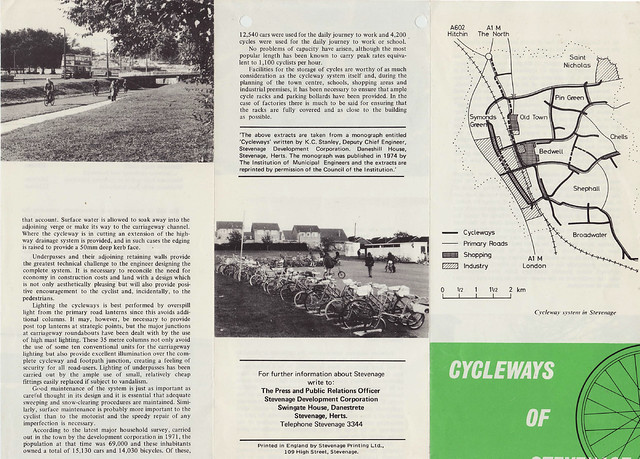
According to a 1975 leaflet on the cycleway system produced by Stevenage Development Corporation, the town’s 69,000 residents owned 15,130 cars and 14,030 bicycles: “Of these, 12,540 cars were used for the daily journey to work and 4,200 cycles were used for the daily journey to work or school.”
This leaflet wasn’t for local consumption, it was produced to give away to those visiting the town on study tours: Stevenage was often wheeled out as an example of how to design a modern town and attracted a great many study tours, which invariably took in the town’s cycleway system. [The leaflet is from the archive of Jan Ploeger, a Dutch cycle campaigner in the 1970s, who visited the town on a study tour. He is now a programme manager for South Holland and gives talks at ‘Go Dutch’ cycling conferences].
The leaflet stresses that the cycleway system was well-maintained with “sweeping and snow-clearing procedures” and that “surface maintenance is probably more important to the cyclist than to the motorist and the speedy repair of any imperfection is necessary.” The importance of cycle parking was also stressed: “Facilities for the storage of cycles are worthy of as much consideration as the cycleway system itself…it has been necessary to ensure that ample cycle racks and parking bollards have been provided. In the case of factories there is much to be said for ensuring that the racks are fully covered and as close to the building as possible.”

THE CYCLE NETWORK THAT TIME FORGOT
Most of the infrastructure built by Claxton in the 1950s and 1960s – and which was a mature network by the 1970s – is still there. [Check it out on Google Street View]. Today, less than three percent of Stevenage residents cycle to work, about the same as the national average. The town’s cycle infrastructure is frozen at about the same quality as the Netherlands in the 1970s.
Very little has been done to extend the 40km network. New housing developments and new shopping centres have been built with easy access for cars but only standard UK ‘crap’ infrastructure for bikes, with seemingly obligatory ‘cyclists dismount’ signs where none are needed. Some cycleways that were formerly continuous are now punctuated by crossings where priority is given to cars. Unlike the roads which they follow, the cycleways are not named, adding to the feeling this is a hidden network. Some signage is missing and what’s there is from the 1970s, an indication that this is an ossified network. Despite lighting, underpasses are dark and, for some users, less than inviting (although similar infrastructure in the Netherlands is well-used). The lack of cycle access to the pedestrianised town centre is a modern aberration, not one engineered by Claxton.
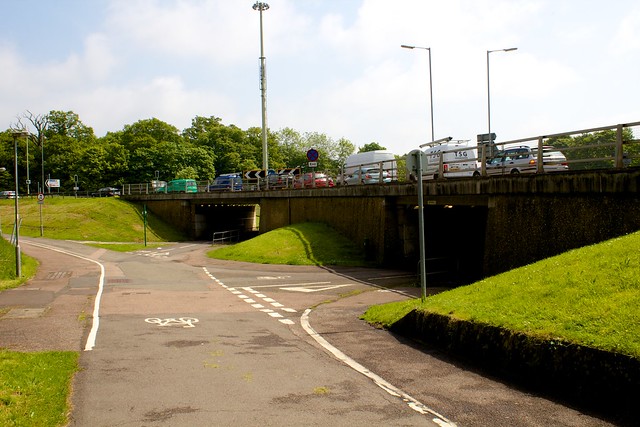
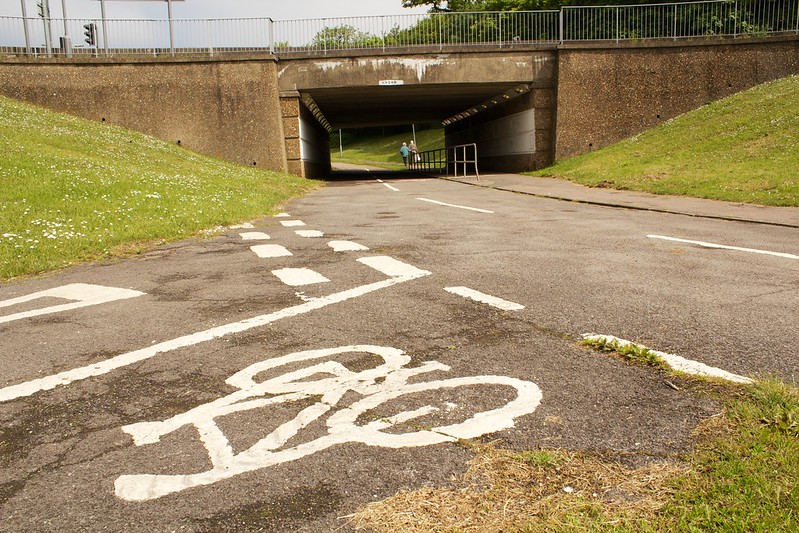
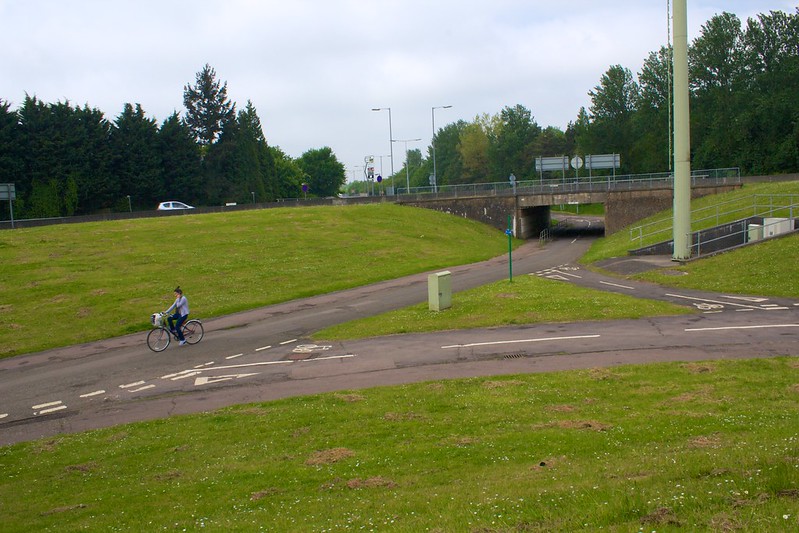
Today’s network may be faded and somewhat less useful than the one Claxton put in place but there are still wide, segregated cycleways next to the primary roads; the underpasses beneath the roundabouts remain; glass and debris is regularly swept up by council clean-up squads; some of the cycleways have been resurfaced recently; and in many places, cyclists and pedestrians are still separated by barriers not just paint. Squint and, where the infrastructure is intact, under the roundabouts for instance, and you could be in the Netherlands. Except there are very few people on bikes.
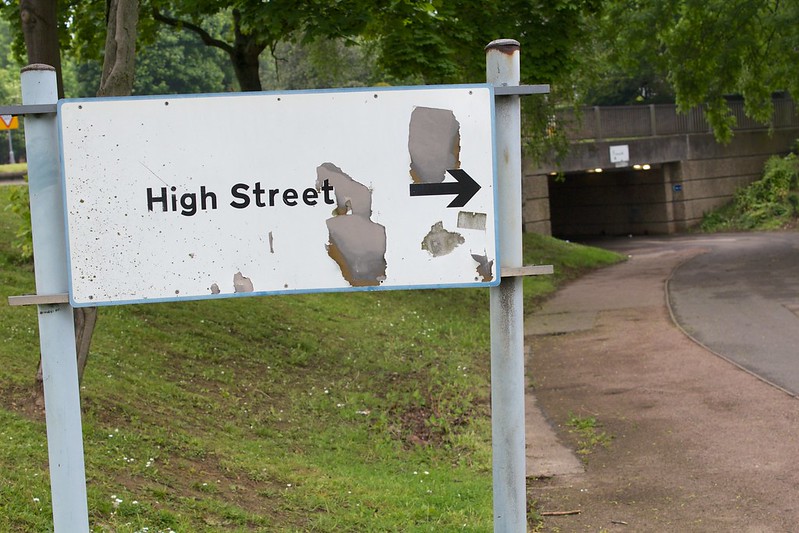
Cyclists in Stevenage have a hidden-in-plain-sight road system all to their selves. Yet pedestrians outnumber cyclists, and on the roads, solo motorists in cars far outnumber both.
Stevenage Borough Council’s defeatist Stevenage Cycle Strategy – not updated since 2002 but still on the council website – is in no doubt why cycle usage is so low:
“Stevenage has a fast, high-capacity road system, which makes it easy to make journeys by car. Residents have largely been insulated from the effects of traffic growth and congestion and generally there is little incentive for people to use modes other than the private car…Stevenage, with its extensive cycleway network, has largely the same level of cycling as other Hertfordshire towns, where facilities for cyclists are less developed. This seems to suggest that the propensity to cycle depends on factors other than the existence of purpose built facilities.”
SIM CITY
Claxton may only have been chief engineer for ten years but Stevenage New Town was largely his creation. He had worked on the New Town plan from the very first inklings of the idea in 1946 and, despite having superiors brought in above him, much to his chagrin, it was he who was in charge of where to place the sewers; he who decided where the new roads would go; he who decided whether or not there was to be a boating lake (there was, he built it at the insistence of his daughter, a primary school teacher who wanted somewhere scenic to take her class); and it was he who insisted that cycleways should be a key and wholly inter-connected part of the town’s transport system. He had to fight to get many of his plans funded but, sometimes by stealth, he managed to secure permission and funding for his cycleways and his cycle bridges and his underpasses.
Claxton’s grand-daughter Joanna Brown told me he was very proud of his cycleways and insisted on calling them that:
“I remember as a child being pulled up for using the wrong term and being told ‘paths are for pedestrians, tracks are for horses, I built cycleways.'”

Evelyn Denington, chair of Stevenage Development Corporation from 1965 until it was wound up in 1980, said in 1992: “One important feature of the town is its segregated cycleways which duplicate the main arteries and feed both the housing and the industrial areas. Mr Claxton was a keen cyclist and was well aware of the need to cater for this enjoyable and excellent mode of travel.”
Claxton was an everyday, practical cyclist not a racing or touring cyclist. He had no truck with cycle campaigners. In fact, when he was a junior engineer in the Ministry of Transport in the 1930s, he wrote to the CTC asking for feedback on the London cycle tracks he had helped to plan: “Imagine my dismay when I received a rather dusty answer from the general secretary. CTC wanted nothing to do with cycle tracks and demanded freedom to use the carriageway – it seemed I had been added to their list of devils hell bent on snatching away such freedom.” (CTC later gave Claxton honorary life membership for “services to cycling.”)
The cycle tracks he worked on in London were sub-standard, admitted Claxton. “As a cyclist they gave me no satisfaction,” he said in his memoirs, published a year before his death in 1993:
“The [London cycle tracks] were too narrow. They were made of concrete and suffered from either cracking or construction joints. They provided protection where the carriageway was safe but discharged the cyclists into the maelstrom of main traffic where the system was most dangerous. For me worst of all the tracks were uni-directional either side of the dual carriageways; thus if for any reason one needed to retrace one’s way, one was compelled to run the gauntlet of crossing the streams of traffic on both carriageways to return on the far side – woe betide the person who left money, keys, books, tools or even lunch behind.”
The engineer was determined not to make the same mistakes when given the task of shaping Stevenage. Claxton’s cycle tracks – now called cycleways to differentiate them from the failed London paths – would be designed with scientific precision: “We were in an era about to give birth to a whole new technology,” said Claxton.
“Organised cycling rejected the [1930s cycle tracks],” he wrote in an academic paper. “However, organised cycling changed its opinion when the Stevenage New Town system had reached a sufficiently advanced stage to be assessed.”
He wrote this paper in 1975 for the Institution of Civil Engineers. Three years after his retirement from the Stevenage Development Corporation he was now a roving ambassador for the town, and, most specifically, the town’s cycleways. His cycle infrastructure consultancy business enabled him to tour the world extolling the virtues of Stevenage’s cycleways.
 Thanks to the oil shocks of the early 1970s there was a growing realisation that reliance on Middle Eastern oil wasn’t terribly bright. In the Netherlands this realisation kick-started the boom in better quality provision for cyclists, building on a rock-solid foundation of already high cycle use. In the UK, where cycling had fallen off a cliff in the 1950s and, by the 1970s, was thought by many to be an urban anachronism, some councils decided to explore whether cycling could be revived. A number of local authorities commissioned Claxton to evaluate cycleways for their towns and cities. Raleigh sponsored Claxton to write a report on behalf of the Corporation of the City of Nottingham; Portsmouth trialled a Claxton-designed segregated cycleway alongside the main road to the docks (the trial was cancelled after businesses along the route complained the lack of car parking impacted adversely on trade); and Claxton helped Peterborough Development Corporation to plan 38 miles of “cross-city cycleways”, separated from motor traffic, and 34 miles of “secondary routes” designated as “cycle priority streets.”
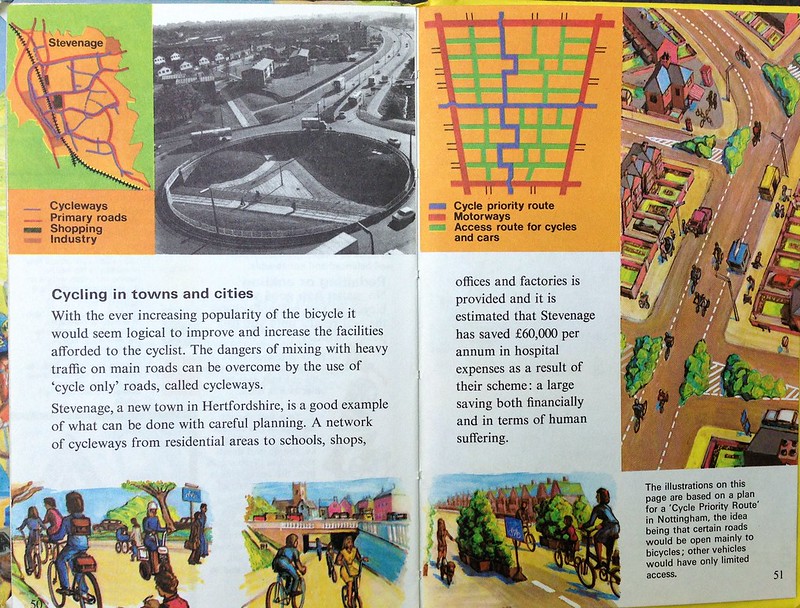
Ladybird’s The Story of the Bicycle of 1975 lauded Stevenage for its “careful planning” and said that the “dangers of mixing with heavy traffic on main roads can be overcome with the use of ‘cycle only’ roads, called cycleways.” This double-page spread in the book also mentions the plans Claxton drew up for the reallocation of roadspace in Nottingham (the plans were not taken forward).
Claxton’s first break in the consultancy business had come from the British Cycling Bureau. This was a PR body run by Planned Public Relations of London and funded by the British bicycle industry via a levy on all bicycles sold. In 1972, George Shallcross, national director of the National Association of Cycle and Motor Cycle Traders, gushed that the appointment of a high-profile figure such as Eric Claxton was “exciting.”
In Motor Cycle and Cycle Trader, for May of that year, Shallcross said:
“The next step is to press for traffic-free cycleways and to make the authorities, national and local, recognise the bicycle as an asset to the environment, as it is noiseless and fume less, and takes up so much less room in parking and riding than motor cars.”

In June 1972, with Claxton as the figurehead, the British Cycling Bureau launched a National Plan for Cycling. Demands for cycle-specific infrastructure were contained in a handbook which stated cycling should be encouraged “before the traffic grinds to a halt.”
The plan said Stevenage was “a place where segregated traffic – motorists and pedestrians and cyclists – has led to increased convenience all round…Stevenage saves £28,000 per year in hospital charges because of the use of cycleways.”
Harold Briercliffe, editor of Motor Cycle and Cycle Trader, said British Cycling Bureau’s National Plan for Cycling was “the most hopeful outline of what we must all do that has been seen in Britain for many a long day.”
The National Plan for Cycling was promoted to national and local government. The British Cycling Bureau organised for Claxton to guide MPs around Stevenage’s cycleways. “All the MPs were very impressed,” claimed Claxton. Despite these efforts, the National Plan for Cycling was roundly ignored by the powers-that-be.
STEVENAGE v HOUTEN
Originally from Surrey, Claxton made his home in Stevenage and was a regular user of the cycleways he had brought into being. He must have been solely disappointed that he was one of the few residents to actually cycle on what was meant to be the British equivalent of a Dutch-style cycleway network. Where did he go wrong? Why does Houten in the Netherlands have such high cycle usage, and Stevenage have such low usage?

Houten underpass. Pic by Amsterdamize.com
There are many differences between Houten and Stevenage but there are also many similarities. Both were expanded as satellite ‘overspill’ towns for bigger cities nearby. Stevenage was planned as a residential relief valve for London, the first of many New Towns envisaged by the motor-centric Abercrombie Plan; Houten was planned as a ‘Groeikern’ – a centre of growth – close to the city of Utrecht. Stevenage’s heyday was in the mid-1970s; Houten was planned from 1966 but expanded fastest in the 1980s.
“In 1968 Dutch architect Rob Derks offered [Houten] a plan heavily focused on filtered permeability: a dense network of direct routes for cyclists and a course network of general roads, offering limited city center access to cars. The city council, which was then made up of civilians and farmers and no politicians, approved Derk’s plan, which they believed would provide a more liveable quality to their city…42 percent of trips shorter than 7.5 kilometres in Houten are made by bike.”
itdp.org [PDF]
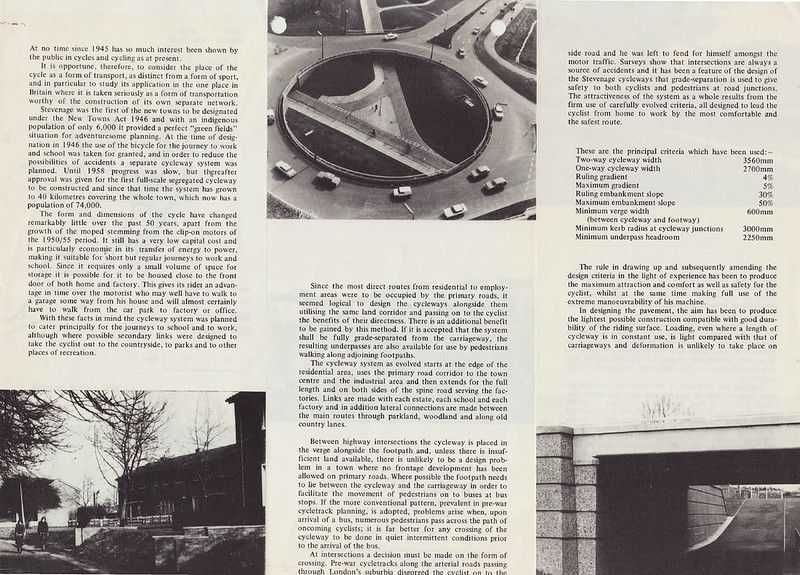
Houten was designed in such a way that it was more convenient to walk and cycle than to drive, and faster, too. This was the case in Stevenage as well: cyclists were provided with safe, segregated cycleways alongside, and slightly below, the main roads and also had cut-throughs unavailable to motor traffic. Cyclists therefore had fast, direct routes between every part of town and also had short-cuts. The 1975 cycleways leaflet said the “cycleway system…starts at the edge of the residential area, uses the primary road corridor to the town centre and the industrial area and then extends for the full length and on both sides of the spine road serving the factories. Links are made with each estate, each school and each factory and in addition lateral connections are made between the main routes through parkland, woodland and along old country lanes.” The cyclists of Stevenage had (and still have) a dense network of safe routes available to them and cyclists, said the 1975 leaflet, had “an advantage in time over the motorist.”
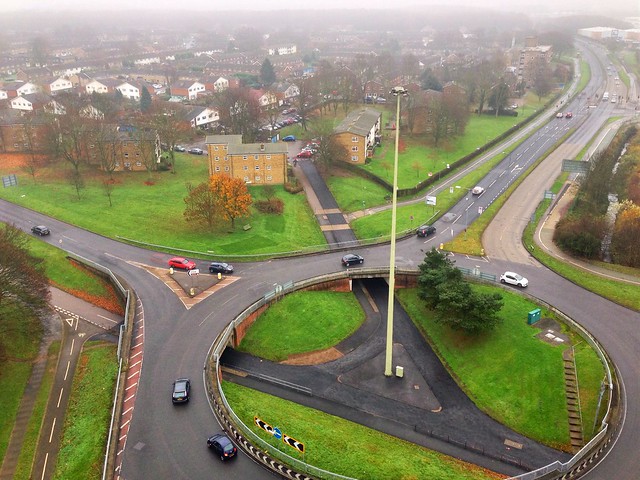
But, critically, motorists in Stevenage were not constrained in any way. In fact, the first New Town was designed to be highly convenient for motorists: cyclists were removed from roads so cars didn’t have to meet slower vehicles; roundabouts kept swift, motorised traffic flowing freely; and traffic lights were kept to a minimum (there was just one set of traffic lights in the whole town).
Much of the superlative cycle infrastructure in the Netherlands was installed in the 1980s, by which time it was clear that the cycleways of Stevenage were being used less and less. The cycle path networks in the Netherlands have been expanded and improved continuously; the cycleway network of Stevenage was left as is. It wasn’t expanded or improved because residents of Stevenage didn’t use the network in large enough numbers. Stevenage’s extensive network of separated cycleways are now used by just 2.7 percent of residents. There are safe cycle routes from homes to schools, but only a tiny proportion of Stevenage’s children cycle to school. Many are ferried by car, a situation that Claxton abhorred: “it is pathetic to see the way some parents bring their child to school by car and later park in the street near to the school to give them a ride home.” Brits, it seems, are in thrall to the car, even when perfectly safe and convenient alternatives to motoring are provided.

Stevenage underpass. By Google Street View.
The car culture of Stevenage is not unusual. In fact, it’s maddeningly mainstream. The British cultural affinity with motoring – even slow, inconvenient motoring – is all pervasive. Perhaps Claxton was trying to force water uphill by promoting cycling to Brits in the 1970s? Perhaps a cycle-friendly New Town built in the future could achieve far more than Stevenage’s current 2.7 percent cycle modal share?
Stevenage’s 1970s multi-modal transport system was held up – by Claxton and many others – as an example of good practice, with walking, cycling, driving and public transport all provided for, almost equally. Very quickly, motoring became the overwhelmingly most popular choice of transport mode. In Stevenage ‘build it and they will come’ worked for cars, yet despite all the best efforts of a chief designer with an empathy for would-be cyclists, it failed for bicycles.
Rachel Aldred, a sociologist at Westminster University’s Department for Planning and Transport, blames car culture:
“Stevenage didn’t generate a cycling revolution primarily for cultural and political reasons. The 1950s were a terrible time to be encouraging cycling in the UK. It simply wasn’t part of mainstream transport policy and discourse. The bicycle signified poverty while the car was an object of desire, particularly in a New Town with wide, free-flowing dual carriageways. The outcome – not particularly high cycling levels – wasn’t just a product of infrastructure, but of infrastructure in its cultural context.
“Car use being so easy in Stevenage did – and does – matter a lot. There may also be an issue related to economic activity and land use. Stevenage’s town centre looked rather run down when I visited, with empty office blocks and betting shops. Where do people work? Where are they trying to get to? It may not be the centre, it might be London or other nearby towns or green field sites, or those new shopping centres that were often built with little consideration for the cycle infrastructure.”
No doubt many of the commuter journeys in Stevenage are out-of-town ones for which people will always tend to choose to drive but this doesn’t explain why cycle to school levels are so low. Some children use the cycleways to get to school (Eric Claxton’s great grandson among them) but no more than the national average i.e. numbingly low.
POST-WAR DREAM
Stevenage was built for Londoners bombed out of their houses and soldiers returning from war; a New Town “fit for heroes to live in”. The compact, socially-engineered town attracted aspirational residents who bought into the post-war dream of car ownership for all. These residents voted with their steering wheels, showing they were happy to live in a town where driving was the absolute norm. The town’s Dutch-style cycling infrastructure did not entice many residents to switch from cars to bikes. Walking was rejected, too. Where driving is easy, Brits drive.
Today, there’s a (slight) movement away from car culture and, if Claxton’s cycleways were built today, in a different place, there might be a different outcome. To get the different outcome in a different place there would need to be a Houten-style restraining of cars. In most localities – where unfettered car-use is seen as a basic human right, a right that is tampered with at a politician’s peril – this will require a cultural u-turn of significant proportions. ‘Build it and they will come’ may not always work for bicycles. This does not mean cycleways should not be built. The new protected bike paths in New York, Seville, Chicago and Vancouver show that cycle use can be increased after the creation of separated infrastructure but cycle infrastructure works best when part of a greater whole, and that usually means restricting car use. When cycling is the fastest, easiest and safest way to get around, cycle use can grow.
High-quality Dutch-style cycle infrastructure is desired by many cycle campaigners (myself included) but the failure of the cycleways of Stevenage (and a modal share of 2.7 percent is a failure) is a warning that infrastructure alone isn’t enough.
John Pucher and Ralph Buehler’s influential report Making Cycling Irresistible says that “The most important approach to making cycling safe and convenient…is the provision of separate cycling facilities along heavily travelled roads and at intersections…”
However, they add:
“separate facilities are only part of the solution. Dutch, Danish and German cities reinforce the safety, convenience and attractiveness of excellent cycling rights of way with extensive bike parking, integration with public transport, comprehensive traffic education and training of both cyclists and motorists, and a wide range of promotional events intended to generate enthusiasm and wide public support for cycling…The key to the success of cycling policies in the Netherlands, Denmark and Germany is the coordinated implementation of [a] multi-faceted, mutually reinforcing set of policies. Not only do these countries implement far more of the pro-bike measures, but they greatly reinforce their overall impact with highly restrictive policies that make car use less convenient as well as more expensive.”

CURB CARS
Eric Claxton was the moving force behind the creation of Stevenage yet there’s no mention of him on the town’s website (update: there is now, thanks to this article and the mainstream media it has inspired, such as BBC’s The One Show). He doesn’t have a wikipedia entry (update: he does now, but it’s not very extensive). He spent the best part of forty years trying to get Brits on bikes yet his name is now known only to a handful of specialist academics and historians. There’s no road – or cycleway – named in his honour.
In 1992, Claxton warned: “What a dreadful example these car drivers are setting for future generations…They become selfish and almost exclusively travel alone…They do not care about others.”


Stevenage’s grade-seperated roundabouts – with cycleways beneath – look a lot like similar roundabouts in the Netherlands. This is De Berenkuil, in Utrecht. And this video shows that the grade-seperated roundabout was planned in 1939 and may have inspired Claxton: he certainly went on Dutch cycle infrastructure tours.
But by not restraining motor vehicle use – and, instead, encouraging it – Claxton is partly to blame for the bad behaviour he describes. The low use of Stevenage’s cycleway network is also probably the fault of Claxton, and his colleagues, because they failed to spot that cycling was a mass mode of transport in the Netherlands for reasons other than provision of infrastructure: culture, history and politics were – and are – major factors. It has been a societal norm to cycle in the Netherlands since the early 1900s but it hasn’t been societal norm to cycle in the UK since the early 1950s. In a few areas of the UK there are pockets of high cycle use, places such as Cambridge and some London boroughs, and in these places there’s a clear case for installing Dutch-style infrastructure. A cycle census by Transport for London has found very high cycle usage on certain roads, where up to 64 percent of the traffic is bicycle traffic. On such roads, where bicycles already dominate, it would be perverse not to provide better, safer facilities. It’s a chicken and egg thing but providing cycle infrastructure in places where there’s not already high cycle usage could lead to underuse of such facilities, as happened in Stevenage.
Cambridge has high cycle usage because it’s a student town and, historically, has restricted student ownership of motorcars via the Special Pro-Proctor for Motor Vehicles; London’s bicycle boom came about through a mix of factors including the congestion charge and the public transport meltdown that followed the 7th July bombings. Cities without high cycle usage, but which want to gain the benefits that such usage brings individually and collectively, would need to restrict usage of cars.
This does not require Soviet-style dictats, changing travel habits can be done by stealth over a number of years. How so? By removing car parking spaces, slowly at first; by reducing motor vehicle speeds by strict enforcement; by placing bollards on rat-runs; and many other well-known measures. Sadly, such measures are collectively known, by media and politicians, as the “war on the motorist”, and in our short-termist political cycles it’s incredibly difficult to do anything that interferes with the sacrosanct Great Car Economy. (Funny how car ownership in the Netherlands and in Germany is higher than here but the cars are used less.)
In designing for bicycle use in Stevenage, Claxton was ahead of his time but by also designing for unfettered car use his cycleways efforts would be wasted. Few foresaw the problems that mass motorisation would bring. Today we’re far more aware of the social, environmental, health and spatial problems of unrestrained car use, but will today’s planners and politicians ever take on the motorised majority to tackle these ills? Can we ‘Get Britain Cycling’ without taming the car?
If the use of private motor cars was discouraged in Stevenage (even just an incy-wincy bit) perhaps the town could experience Dutch levels of cycle use? And here’s what it could look like. Almost. This photograph is a composite of 27 cyclists using a Stevenage cycleway, with some trickery done by photographer Trevor Coultart. He took pix of cyclists passing the same spot over the space of an hour and later merged them together via Photoshop layers. A clever bit of wishful thinking … The pic is © Trevor Coultart 2013, all rights reserved.

Eric Claxton (1909-1993), O.B.E., B.Sc., C.Eng., F.I.C.E.
102 thoughts on “Where driving is easy, Brits drive”