Roads Were Not Built For Cars

American and British cyclists of the 1890s saved roads for ALL users

  • Book info
  • Clicky-flicky book preview
  • iPad book preview
  • Twitter
Roads Were Not Built For Cars
November 30, 2012 by carltonreid

Parking private property on the street is a modern malaise (and not done in Japan)


Send to Kindle

In last week’s Sunday Times, the newspaper’s ‘motormouth’ correspondent Mike Rutherford wrote:

“Parking is now officially, in my book at least, one of the undisputed rip-offs of the decade.” He claims he will no longer pay for “heinously expensive spaces” and will be “refusing to drive or visit town centres and using out-of-town shopping centres instead.”

Rutherford, like many motorists, believes private property (cars) should be allowed to be stored on public infrastructure (roads) paid for not by motorists but by all tax payers. Many of those who live beside roads believe they have the absolute right to park outside their front door, even though such rights rarely exist.

This belief in the unalienable right to park, for free, anywhere where there’s not a double yellow line or a pay car park, is a strong one. And it’s relatively new.

Up until the 1920s, few people had cars and those that were owned were usually accommodated off the public highway when not in use. Cars were stabled, just as horses had been done before the advent of the ‘horseless carriage’.
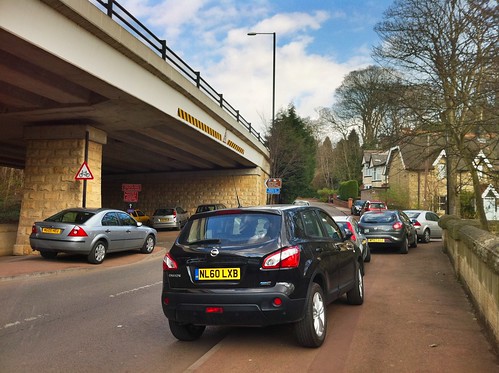
bentonbridgeparking

Now it’s difficult to get moved on many urban roads because they’re narrowed by parked cars, very often illegally parked cars, with two wheels on the part of the highway meant for pedestrians.

Such storage of private property on the public highway would have been unthinkable to previous generations, as was pointed by the brilliant economist Ralph Turvey – a professor at the LSE and economist for the World Bank and other organisations – in his classic treatise ‘Street Mud, Dust and Noise’ (London Journal 21, 1996).

Professor Turvey wrote:

“In the nineteenth century the streets were clear from kerb to kerb for the sweepers, water carts and broom machines to do their work in the small hours. Horses and carts or carriages were not left in the street at night, and when – a rare occurrence – unhorsed cabs were left all night on carriageways, the offenders were fined. Victorian London may have been smelly, dusty and muddy, but it had no parking problem.”

Bit by bit we have allowed private property to be dumped in public spaces, and most people don’t give this a second’s thought.

And it doesn’t have to be this way. In Japan, in order to own a car, you must prove that you have a off-street parking space. This parking certificate is called shako shoumei, named for the Shako Law, in force since 1958.

In the UK no such proof is required. We endure clogged streets, dangerous for pedestrians, cyclists and motorists, but this is seen as normal. It wasn’t normal in the past and it’s not normal in every other car-saturated nation.

With less parked cars blocking roads (and pavements), our towns and cities would be better places to live.

www.simplesharebuttons.comShare away...FacebookTwitterEmailLinkedInDiggStumbleUponReddit
Posted in 1890s, Automotive history, Pedestrianisation, Road rights. RSS 2.0 feed.
« “The object of a retail tradesman is to get as many people as he possibly can in a street”
Why is cycling popular in the Netherlands: infrastructure or 100+ years of history? Both »
  • RobC

    Residents on a new housing estate in Corby who block roads with cars – often two per house, moan that the estates were ‘badly designed’ when ticketed for blocking roads for emergency vehicles rather than maybe they should adjust their expectations to where they have chosen to live. I think most houses were designed with off street parking for one car.

  • http://twitter.com/1dangerouself MarkDangerousElf

    TOO often, people think their property (the car) has MORE RIGHTS than another CITIZEN. Sad that this level of delusional entitlement exists.

  • Colin

    Currently dealing with a guy who insists on parking his car on the pavement outside his house. He refuses to park on the road as he’s a fire-fighter and the street would be too narrow for a fire engine if he parked there. That, perhaps, it was designed like that so it would always be clear is too much for him to grasp. He has a driveway.

    Meanwhile, around the corner, there are households that park fully on the wide path (it’s nominally a cycle path, part of an official cycle network that isn’t marked) despite a chunk of the road being redesigned and marked to give them a parking space.

    • http://www.quickrelease.tv carltonreid

      Why not park it on the driveway?

About the book

  • Book info
  • Kickstarter information
  • Privacy & T/Cs

Thanks to

Brompton

Free PDF tx to:

Tern

Recent posts

  • “Copenhagen swarms with riders during all hours of the day”
  • US senator: “[Automobiles are the future but] I cannot conceive our active Americans in carriages moved by any other motor but the horse”
  • Reallocation of roadspace: here’s how Birmingham’s Victoria Square did it
  • A gamble or a sure thing? Here’s how to succeed with Kickstarter (& don’t forget the deductions)
  • Cities are not set in stone, stone can be moved

Recent Comments

  • Masamba Zuberi on Ride your bicycle on a Sunday? Go to Hell!
  • Mark Calvin on Detroit’s most famous cyclist: Henry Ford
  • carltonreid on The sad tale of a cycle network innovator forgotten by the New Town he built
  • rich257 on The sad tale of a cycle network innovator forgotten by the New Town he built
  • Anonymous on A gamble or a sure thing? Here’s how to succeed with Kickstarter (& don’t forget the deductions)

Thanks to

Chain Reaction Cycles dot com

Blogroll

  • Chartered Institution of Highways & Transportation
  • CTC – sticking up for cyclists since 1878
  • Cycling Embassy of GB – sticking up for cyclists since 2011
  • How We Drive
  • iPayRoadTax.com
  • Joe Moran's Blog
  • League of American Cyclists – sticking up for cyclists since 1880
  • Rees Jeffreys Road Fund
  • Road.cc
  • Wheelmen

Thanks to

Chain Reaction Cycles dot com

Book free due to:

ChainReactionCycles

Archives

Categories

Pages

  • Book info
  • Kickstarter information
  • Privacy & T/Cs

Contact

CARLTON REID
carltonreid@mac.com
LinkedIn
Twitter
Tel: +44 191 265 2062

Clicky-flicky pitch

You can learn more about this e-book in the 8-page pitch on issuu.com. If you're accessing this site from an iPad, click on the iPad-specific link instead.

Book free due to:

cycle-claims
ChainReactionCycles

All content © 2013 by Roads Were Not Built For Cars. WordPress Themes by Graph Paper Press